10 Results for "

Toxicodendron vernicifluum (Stokes) F. A. Barkl.

" in MedChemExpress (MCE) Product Catalog:
Products (10)

10 Results for "Toxicodendron vernicifluum (Stokes) F. A. Barkl." in MCE Product Catalog:

2
2 Cited Publications
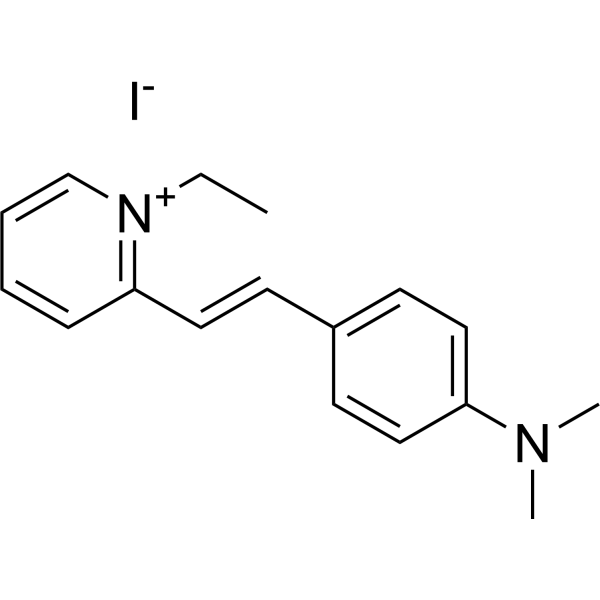
Cat. No.: HY-W247131
CAS No.: 3785-01-1
DASPEI is a cationic styrenyl mitochondrial dye with large Stokes shift. DASPEI has excitation and emission wavelength at 550/573 nm, which has good light chromogenic property. DASPEI can stain mitochondria in living cells with good labeling property. And DASPEI can also be used to stain presynaptic nerve endings independently of neuronal activity .
loading...
    loading...
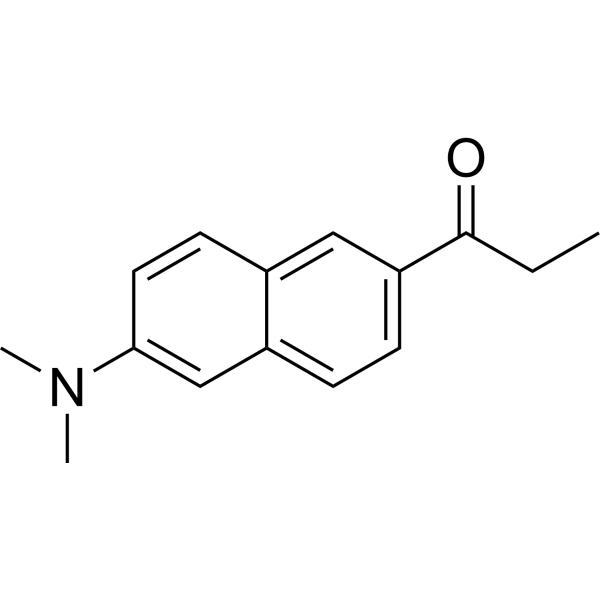
Cat. No.: HY-D0074
CAS No.: 70504-01-7
Prodan, a solvatochromic fluorophore, has been used as a microenvironment-sensitive membrane reporter. Based on the chemistry of Prodan, fluorescent nucleosides are designed and synthesized.The fluorescent nucleosides sensitively varied the Stokes shift values depending on the orientational polarizability of the solvent .
loading...
    loading...
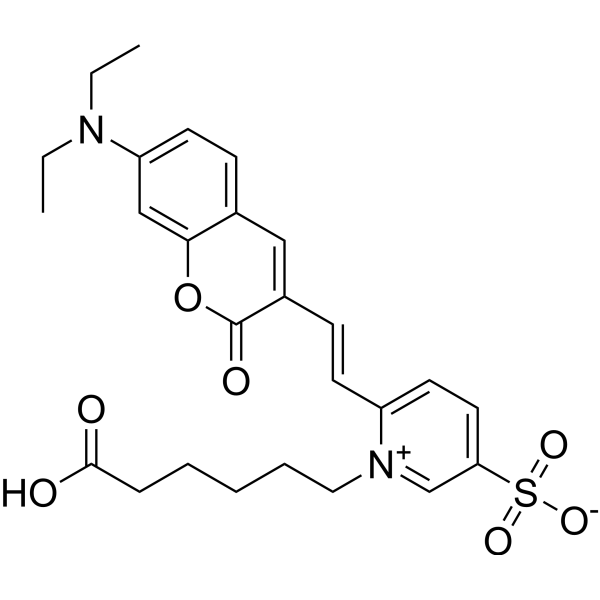
Cat. No.: HY-D1497
CAS No.: 540528-00-5
Fluorescent Red Mega 480 is a dye that is specifically designed for multicolor techniques. Fluorescent Red Mega 480 is characterized by an extremely large stoke′s shift between excitation and emission maxima .
loading...
    loading...
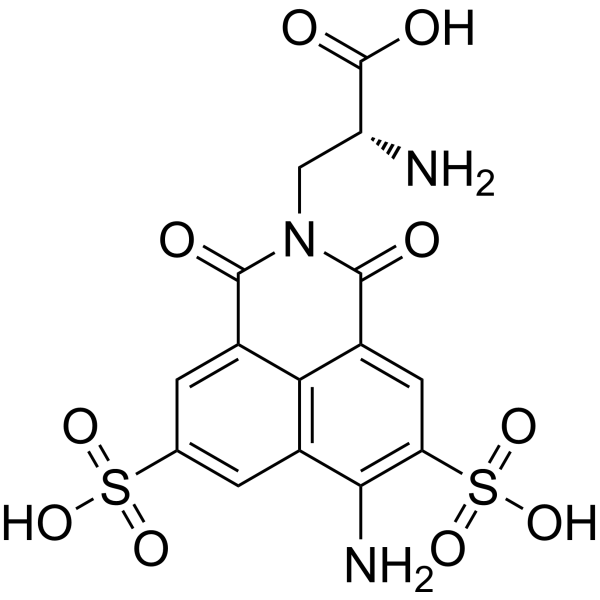
Cat. No.: HY-D1189
CAS No.: 1471982-33-8
Synonyms: Lucifer Yellow 3-amino-D-alanine
YADA (Lucifer Yellow 3-amino-D-alanine) is a conjugate of the fluorescent dyes Lucifer yellow and D-alanine, which is a green-yellow fluorescent dye. YADA is suitable for labeling peptidoglycans in living bacteria that can be incorporated into the cell wall where they are being synthesized. YADA has a large Stokes shift and a wide emission spectrum, allowing excitation through a purple light source and detection using a green filter. YADA showed good water solubility, light stability and thermal stability.
loading...
    loading...
Cat. No.: HY-N19844
CAS No.: 5862-27-1
3-Heptadecylcatechol is an urushiphenol compound found in Toxicodendron vernicifluum resin and poison oak urushiol. 3-Heptadecylcatechol exhibits anti-platelet aggregation and immune regulation activity. 3-Heptadecylcatechol can be used for the research of thrombotic disorders .
loading...
    loading...
Cat. No.: HY-D2194
AgAuSe-COOH (1000 nm) is a fluorescent quantum dot that emits fluorescence in the near-infrared II region, with an emission peak reaching 1000 nm. AgAuSe-COOH (1000 nm) has the advantages of narrow band gap, large Stokes shift, and good photostability. AgAuSe-COOH (1000 nm) can bind proteins, antibodies, peptides, PEG, etc., and can be widely used in the field of biological imaging.
loading...
    loading...
Cat. No.: HY-D2968
CAS No.: 2759816-87-8
DCM-ONOO is a near-infrared two-photon fluorescence probe specifically designed for real-time monitoring of the dynamic fluctuations of peroxynitrite (ONOO⁻) in epilepsy models. DCM-ONOO exhibits excellent optical properties, with a single photon excitation (Ex) of 520 nm; a single photon emission (Em) of 685 nm; a two-photon excitation of 820 nm; and a Stokes shift of 165 nm. When DCM-ONOO is combined with ONOO⁻, it shifts from 460 nm to 512 nm, and only generates a significant fluorescence response to ONOO⁻. DCM-ONOO has been successfully applied to rat epilepsy models .
loading...
    loading...
Cat. No.: HY-N1764
CAS No.: 38412-82-7
3,4,4',7-Tetrahydroxyflavan is a Flavonoids product that can be isolated from the barks of Toxicodendron verniciflua .
loading...
    loading...
Cat. No.: HY-184604
Silver nanoclusters (AgNCs) are ultrasmall nanoparticles composed of several to tens of silver atoms. Their size is close to the Fermi wavelength of electrons, thus exhibiting unique molecular-like properties, such as strong fluorescence. Silver nanoclusters possess small size, low toxicity, excellent photostability, large Stokes shift, and good biocompatibility. Lipoic acid (also known as octylsulfonic acid) acts as a ligand in the synthesis of silver nanoclusters, primarily playing a role in stabilizing and protecting the silver nanoclusters. The ligand binds to silver atoms through its specific chemical structure, forming a stable nanocluster structure and influencing the physicochemical properties of the clusters, such as fluorescence performance, catalytic activity, and biocompatibility. This demonstrates potential application value in various fields such as chemical analysis, biosensing, catalysis, medicine, and bioimaging.
loading...
    loading...
Cat. No.: HY-184605
Metal nanoclusters, containing anywhere from a few to hundreds of atoms, bridge the gap between nanoparticles and molecular compounds, typically exhibiting molecular-like electrical and optical properties. Furthermore, metal nanoclusters possess advantages such as significant Stokes scattering and size- and ligand-dependent fluorescence characteristics, making them an emerging class of materials for constructing fluorescence platforms. Current research primarily focuses on the synthesis and application of noble metal nanoclusters like gold and silver. However, copper, belonging to the same group as gold and silver in the periodic table, is inexpensive, environmentally friendly, readily available, has a simple preparation process, and low toxicity, making it widely applicable in industry. In addition, copper nanoclusters exhibit better photostability than organic dyes and better environmental friendliness than semiconductor quantum dots, making them suitable for trace detection.
loading...
    loading...

